


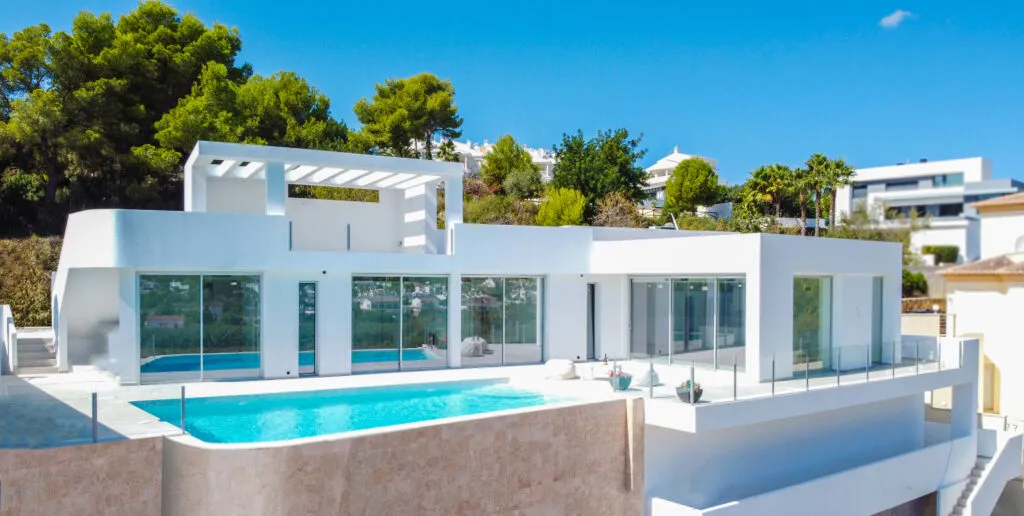
You can plan and build a new home on the Costa Blanca while you still live in London, Düsseldorf, Amsterdam or Stockholm. Many people do exactly that, and arrive when the house is ready. What makes it work is understanding the Spanish process before you start, and having a reliable construction team in Moraira or wherever you build.
This guide walks through each stage from the perspective of someone building from abroad, using Moraira and the northern Costa Blanca as the example. Most of the legal framework is national or regional, so it applies widely in Spain; a lawyer can confirm the details for your situation.
Can you really build in Spain without living here?
Yes. Spain does not require you to be resident to buy land or build a home. Most of the work can be done remotely: meetings, design reviews, choosing finishes and following progress on site. You will usually want to visit a few times, for example to see the plot before buying, for signatures and to walk through the house before handover, but how often you come is up to you.
Step 1: The basic paperwork
The NIE (Número de Identidad de Extranjero) is your foreigner identification number. You need it for any tax-related transaction in Spain, such as buying property or opening a bank account. Non-residents can apply for it at a Spanish embassy or consulate in their home country, or through a representative in Spain.
Some buyers also open a Spanish bank account or grant a power of attorney (poder notarial) so that someone they trust can sign documents in Spain on their behalf. Whether you need either depends on your situation.
Step 2: Choose and check the plot
The plot decides your views, your privacy, your budget and what you are allowed to build. Around Moraira many plots are on hillsides, which affects foundations, retaining walls and access. A plot that looks cheaper can end up costing more once the groundworks are added.
Before you commit, make sure these points are checked:
- Planning status. The land should be classified as urban and buildable. An urban-planning certificate from the town hall sets out what you can build: buildable area, height, plot occupation and distances from boundaries.
- Ownership and charges. A nota simple from the Property Registry confirms who owns the land and whether there are any charges on it.
- Services and access. Is there road access, water, electricity and drainage? If not, find out what connecting them involves.
- Ground conditions. A geotechnical study tells the architect how to design the foundations.
- Orientation and slope. These shape the design, the light, energy use and excavation.
If you cannot visit, a builder or architect can carry out the first assessment for you. At First Estate Construction we review plots for clients living abroad and can provide a drone video so you can see the site, its access and its views. We also have building plots available in Moraira and elsewhere on the Costa Blanca.
Step 3: Design, licence and the professionals involved
Spanish building projects involve several professionals, each with a defined legal role:
- The architect designs the house in stages: the anteproyecto (preliminary design) sets the layout and volume; the proyecto básico (basic project) is used to apply for the licence; the proyecto de ejecución (execution project) contains the full technical detail needed to build.
- The technical architect (arquitecto técnico or aparejador) oversees the execution of the works and the quality of materials. Together with the architect, they form the dirección facultativa, the technical management team.
- A health and safety coordinator is appointed for the works.
- The builder carries out the construction according to the execution project.
With the basic project ready, an application is made to the town hall for a major works licence (licencia de obra mayor). In Moraira that means the Ayuntamiento de Teulada-Moraira, because Moraira and Teulada form a single municipality. The town hall charges a licence fee and the construction tax (ICIO), which is calculated on the construction budget.
Under Valencian planning law, the town hall has two months to decide on a complete application for a new building. In practice it can take longer, for example when corrections or additional documents are requested. A complete, well-prepared application helps avoid delays.
At First Estate, the design is developed by our in-house architect or by one of our partner architects, including 3D visualisations so you can see the house before construction starts. There are several ways to handle the licence application, and all of them are available; we agree with each client the one that suits their project.
Step 4: Managing the build from abroad
This is where most people worry: how do you know what is happening on site when you are 2,000 kilometres away? Good practice looks like this:
- Direct contact with your builder. At First Estate you can call us at any time, not only on scheduled dates.
- Reports at every stage. We report on progress at each stage of construction, and at any other time on request.
- Decisions planned ahead. Choose kitchens, tiles, bathrooms and exterior finishes early, so the work never waits for you to fly in.
- Visits at key moments. Plan them for when they matter to you, for example when the structure is complete or before the finishes.
Construction in Spain normally follows this sequence: earthworks and foundations, structure, envelope and roof, installations (electricity, plumbing, climate control and telecoms), and then interior and exterior finishes. The pool, terraces and landscaping usually come at the end.
Step 5: Completion and moving in
When construction is finished, there are still several formalities before you can live in the house:
- the final works certificate, signed by the technical management team;
- the building file (libro del edificio), with the technical documentation and maintenance instructions for the home;
- the first-occupation licence or responsible declaration, depending on the municipality;
- the new-build deed at the notary, and registration with the Property Registry and the Cadastre;
- utility contracts such as electricity and water in your name.
Budget: what to include beyond the build itself
When you compare proposals, make sure your budget also covers:
- the plot, plus the taxes and notary costs of buying it;
- architect and technical fees, surveys and the geotechnical study;
- the licence fee and ICIO;
- VAT on construction: in Spain, 10% applies when you contract the builder directly to build your own home;
- external works such as the pool, terraces, landscaping, driveways and boundary walls;
- utility connections, and a reserve for changes you decide on along the way.
Every custom villa is different, so we prepare an individual estimate after a first conversation about your project. For more detail, see our guide to the cost of construction in Moraira.
How long does it take?
It depends on the plot, the design and the licence process: every custom villa is different. The stages, however, are always the same: finding and checking the plot, design, licence, construction and completion. Planning them early is the best way to plan your move with confidence.
Checklist for buyers abroad
- Get your NIE and decide whether you need a Spanish bank account or a power of attorney.
- Have the plot checked: planning certificate, nota simple, services, geotechnical study.
- Agree the design and budget before the licence application.
- Agree how you will stay in touch with your builder and how you will receive reports.
- Choose your finishes early.
- Plan your visits around the key stages.
Planning your home in Moraira?
First Estate Construction is based in Moraira and has more than 15 years of experience building and renovating homes across the Costa Blanca, including Moraira, Jávea, Benissa, Benitachell, Cumbre del Sol and Calpe. Our in-house architect and partner architects, engineers, project managers and construction team guide your project from the plot to the keys, wherever you live today.
Tell us about your plans: request a construction quote, call +34 604 44 25 42 or write to [email protected]. You can also see our projects.